The Ultimate Beginner’s Guide: How to Make a Bubbly Sourdough Starter From Scratch in 7 Days
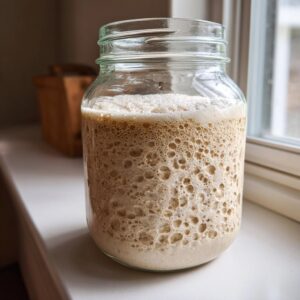
Learn how to create your own active, bubbly sourdough starter using only flour and water. This day-by-day guide provides simple steps for beginners to cultivate their own natural leavening culture for artisan bread making.
- Prep Time: 5 min daily
- Cook Time: 0 min
- Total Time: 7 days active maintenance
- Yield: 1 active wild yeast culture 1x
- Category: Baking Foundation
- Method: Fermentation
- Cuisine: Global
- Diet: Vegan
Ingredients
Scale
- 100g Whole Grain Flour (Rye or Whole Wheat recommended for initial activation)
- 100g Unbleached All-Purpose Flour
- 100g Unchlorinated Water (room temperature)
Instructions
- Day 1: Initial Mix. In a clean glass jar, combine 50g of whole grain flour and 50g of room temperature water. Stir well until no dry spots remain. Cover loosely (a coffee filter or loose lid works) and leave at room temperature (68-75°F) for 24 hours.
- Day 2: Rest. You may see little to no activity. Do nothing today. Keep the jar covered loosely at room temperature.
- Day 3: First Feed. Discard half of the mixture (about 50g). To the remaining starter, add 50g of all-purpose flour and 50g of water. Mix thoroughly. Cover loosely and let sit for 24 hours. You might see some small bubbles.
- Day 4: Increased Feeding. Discard half of the starter. Feed with 50g all-purpose flour and 50g water. You should see more consistent bubbling activity now.
- Day 5: Twice Daily Feeding Begins. Discard half of the starter. Feed with 50g all-purpose flour and 50g water. After 12 hours, repeat this feeding process (discard half, feed 50g flour, 50g water). Look for the starter to double in size between feedings.
- Day 6: Building Strength. Continue the twice-daily feeding schedule (discard half, feed 50g flour, 50g water every 12 hours). The starter should be very active, showing many bubbles, and smelling pleasantly sour.
- Day 7: Readiness Check. If your starter consistently doubles in volume within 4 to 8 hours after feeding, it is active and ready to bake with. If not, continue the twice-daily feeding until it shows this reliable rise and fall pattern.
Notes
- Use a clear jar so you can track the rise and fall of the culture.
- If you see mold or pink/orange streaks, discard everything and start over; this indicates bad bacteria growth.
- For long-term storage, place your established sourdough starter in the refrigerator after feeding it. Feed it once a week to keep it alive.
- To prepare a refrigerated starter for baking, take it out, discard most of it, and feed it twice a day at room temperature until it reliably doubles again.
Nutrition
- Serving Size: N/A (Culture)
- Calories: 0
- Sugar: 0
- Sodium: 0
- Fat: 0
- Saturated Fat: 0
- Unsaturated Fat: 0
- Trans Fat: 0
- Carbohydrates: 0
- Fiber: 0
- Protein: 0
- Cholesterol: 0