

There is nothing that settles the heart quite like the aroma of a glorious roast filling your kitchen, especially when that roast is destined to be the centerpiece of a special gathering. For years, I admit, achieving that perfect medium-rare, melt-in-your-mouth result felt like luck rather than science. But after my culinary training and countless hours spent testing techniques, I can finally share what I consider the best easy oven-roasted herb crusted prime rib recipe. This method is truly foolproof; it’s the one I developed to ensure your effort results in a stunningly juicy and tender roast every single time. Trust that every measurement here has been meticulously tested in my kitchen, just like the guidance you’ll find in my other oven-roasted prime rib recipe, so you can host with confidence.
- Why This Is the Best Prime Rib Recipe for Your Holiday Main Course Beef
- Gathering Ingredients for Your Herb Crusted Prime Rib
- Oven Roasted Prime Rib Instructions: Achieving Melt in Your Mouth Beef
- Tips for Success with Your Foolproof Prime Rib Recipe
- Serving Suggestions for Your Perfect Holiday Roast
- Storage and Reheating Instructions for Leftover Prime Rib Recipe
- Frequently Asked Questions About Cooking Prime Rib
- Estimated Nutritional Data for This Prime Rib Recipe
- Share Your Christmas Dinner Beef Masterpiece
Why This Is the Best Prime Rib Recipe for Your Holiday Main Course Beef
If you’ve ever stayed up late worrying if your big holiday main course beef will turn out dry, I get it. That’s why I spent so much time perfecting this two-temperature strategy. It delivers that enviable, deeply flavorful herb crust while guaranteeing that the inside remains unbelievably juicy. Honestly, this is the best prime rib recipe because it eliminates the guesswork. You get that restaurant-style presentation, but with steps designed for the home cook. It’s the absolute key to nailing that perfect holiday roast without losing sleep before your guests even arrive.
I promise, once you taste this melt-in-your-mouth beef, you’ll never look back. For more trusted recipes developed with my culinary background, you can always browse my full collection right here.
Gathering Ingredients for Your Herb Crusted Prime Rib
The success of any impressive roast starts right here, with quality components applied with care. For this recipe, you’ll need a beautiful prime rib roast, ideally bone-in, generally between five and seven pounds so we have enough meat for that stunning final slice. Make sure you pull that roast out early—at least two or three hours before you plan to cook—so it can truly reach room temperature; that’s foundational for even cooking.
For the incredible herbaceous coating, grab your olive oil to help everything stick, a generous amount of sharp fresh garlic, and most importantly, fresh rosemary and thyme leaves. Don’t skimp on the herbs; they create the fragrant barrier that seals in moisture. Salt, pepper, onion powder, and a secret ingredient finish the rub. When developing this recipe, I found that using celery seed is what gives a hint of that restaurant style prime rib copycat flavor we all love.
Ingredient Notes and Substitutions for Your Prime Rib Recipe
When it comes to herbs, fresh is truly best here. If you absolutely must use dried herbs instead of the fresh rosemary and thyme, remember that dried herbs are much more concentrated. I suggest using about one-third the amount called for if you are pulling them from the spice rack. But if you can manage it, snip those fresh herbs; the scent while roasting is part of the joy! And please, use kosher salt—it adheres better to the olive oil base than fine table salt does.
Oven Roasted Prime Rib Instructions: Achieving Melt in Your Mouth Beef
This is where the magic really happens, and trust me, it’s easier than you think! We are using a two-temperature approach here, which sounds fancy, but it’s actually the best way to get that shatteringly crisp herb crust while keeping the center of your roast spectacularly juicy. When I finally stopped just guessing the time and started trusting my thermometer, that’s when I truly mastered the prime rib recipe. I remember the first time I pulled a roast perfectly medium-rare; I actually cheered in the kitchen! That guaranteed success is what this method gives you.
Remember, even though this is an easy roast, it requires your attention during the active cooking windows. You’ll want to have your roasting pan and rack ready to go before you even touch the meat!
Prepping the Prime Rib Roast Bone In for Maximum Flavor
First things first: ensure that beautiful roast has been chilling out on the counter for those crucial 2 to 3 hours. Cold meat hitting a hot oven is just asking for uneven cooking. While it warms up, let’s make our paste. Scoop that minced garlic, rosemary, thyme, salt, pepper, onion powder, and that celery seed into a small bowl. Mix it around until you have a fragrant, slightly coarse paste.
Now, drizzle the whole roast with your olive oil so everything has something to grab onto. Then, dive in and rub that herb mixture onto every inch of the beef surface. Don’t be timid; press it in firmly. If you are using a prime rib roast bone in, place it fat-side up on the rack in your pan, letting those bones act like little stilts to lift the meat perfectly.
The Juicy Prime Rib Method: Searing and Slow Roasting
Time for the oven! Preheat it to a blasting hot 450°F. We are going to give this herb crusted prime rib a quick blast of high heat—just 15 minutes. This sets that beautiful crust we worked so hard to create. Don’t open the oven door during this time; keep that hot air contained for the sear.
After exactly 15 minutes, dramatically lower the heat to 325°F. You don’t even need to open the door to adjust the setting on most modern ovens, but if you do, be quick! Now, continue roasting. This is the crucial part of our juicy prime rib method: you must use a reliable meat thermometer. For medium-rare, you are aiming for 125°F when you start checking. At 325°F, this usually takes about 13 to 15 minutes per pound. The second you hit that temperature milestone—pull it out! It needs to come out 5 to 10 degrees early because of resting (I’ll explain in a second!).
Resting and Carving Your Tender Slow Roasted Beef
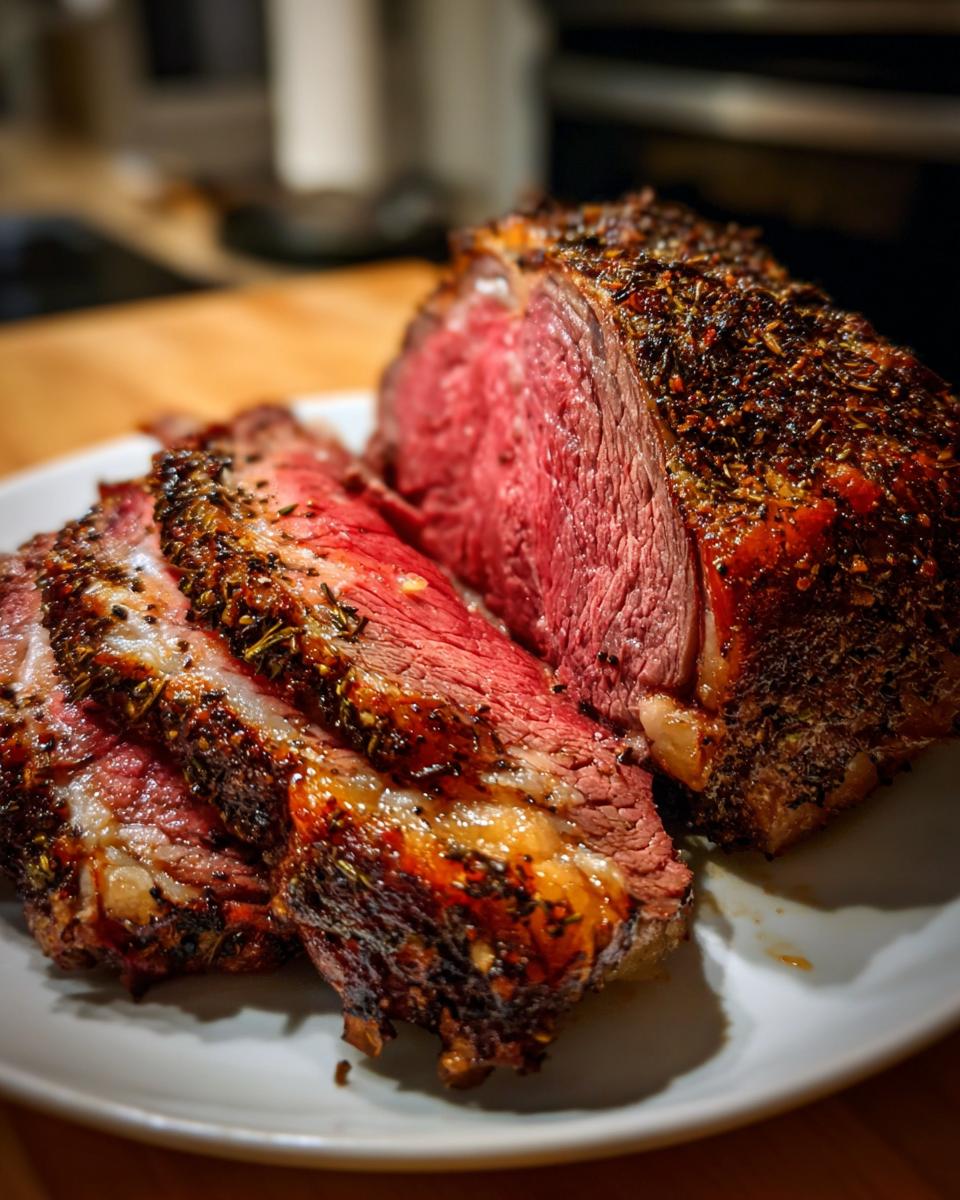
Resist the urge to slice this magnificent roast immediately! Seriously, cover the whole thing loosely with aluminum foil—creating a little tent so the foil doesn’t stick to the crust. It needs to rest for a minimum of 20 minutes, and honestly, 30 is even better, especially for a large roast. During this resting time, the juices, which have been driven to the center by the heat, migrate back out into all the muscle fibers. This carryover cooking also brings the internal temperature up to that perfect final point. It’s the secret to that tender slow roasted beef.

Once rested, take your sharpest knife and slice straight down, always cutting against the grain you can see in the meat. That first slice should reveal the rosy pink center you’ve worked for. This technique truly delivers that melt in your mouth beef experience every time.
If you need a refresher on other oven techniques, you might find my guide to slow cooker pot roast useful when aiming for tender results in different ways!
Tips for Success with Your Foolproof Prime Rib Recipe
Making a magnificent roast like this doesn’t require luck, just a few key confirmations before you serve it up. The most important tool in your entire kitchen for this prime rib recipe is a reliable meat thermometer. I can’t stress this enough; guessing the doneness is what separates a stunning roast from a dry one. Make sure you are reading the temperature from the very thickest part of the meat, but avoid letting the tip touch bone, which will give you a falsely high reading.
Also, please respect the rest! That 20 to 30 minutes where it just sits under foil is non-negotiable. It’s where the meat reabsorbs all the lovely, flavorful juices we worked to keep inside during the cook. You’re basically guaranteeing that tender slow roasted beef texture.

Now, if you are someone who prefers a more gradual approach, remember you can skip my initial high-heat blast. The alternative technique, just roasting the whole way through at a lower temperature, like 275°F, also produces incredible results, though it takes significantly longer. Either way, these steps ensure you get that impressive main course you’re aiming for. You can find more of my favorite reliable main dishes over here!
Serving Suggestions for Your Perfect Holiday Roast
That rich, savory roast deserves sides that complement its majesty without fighting it, doesn’t it? Since my heart sings for those vibrant, fresh Mediterranean flavors, I always lean toward bright vegetables. Instead of heavy starches, try some simple roasted carrots and parsnips tossed with a drizzle of olive oil and a splash of sherry vinegar once they come out of the oven. That little bit of tang cuts through the richness beautifully.
For greens, barely steamed asparagus or lightly sautéed Swiss chard with lemon zest adds that pop of color and freshness. When it comes to wine, you simply can’t go wrong with a bold Cabernet Sauvignon from Napa or a beautiful, earthy Bordeaux. They have the structure to stand up to all that incredible beef flavor. All my favorite supporting actors for a big meal can be found on my side dishes page!
Storage and Reheating Instructions for Leftover Prime Rib Recipe
Even though this massive roast rarely lasts long, sometimes you are lucky enough to have some magnificent leftovers! You absolutely must store any leftover prime rib recipe slices in a very airtight container in the fridge. I recommend slicing the meat thinly before storing it, as that makes reheating much quicker.
When it comes time to enjoy that last bit of your roast, the key is moisture. Don’t microwave it plain! I always reheat the thinly sliced beef gently in a skillet over low heat, adding just a splash of beef broth or au jus to prevent it from drying out. It needs to warm through slowly so you keep that melt-in-your-mouth texture. Resist the urge to rush it; low and slow works for leftovers too!

Frequently Asked Questions About Cooking Prime Rib
When you’re dealing with a show-stopping piece of meat like this, it’s natural to have a few lingering doubts before you commit to the oven. I’ve collected the questions I get asked most often about making sure this works out perfectly for everyone.
What internal temperature is ideal for a medium-rare prime rib recipe?
If you are aiming for that beautiful rosy center—what I consider perfection for this prime rib recipe—you need to be militant about your thermometer! You should actually pull the roast out of the oven when your thermometer reads 125°F (52°C). I know it seems low, but that carries over cooking during the 20-minute resting period brings it up almost exactly to the target medium-rare of 130–135°F. Trust the resting period; it’s what keeps the center of your holiday main course beef so juicy.
Can I make this easy prime rib roast ahead of time?
I strongly advise against cooking the roast entirely ahead of time. A roast like this is meant to be served warm, and trying to reheat a whole joint often leads to dry edges. However, you can certainly do prep work! I often mix up that incredible herb paste—the rub ingredients—earlier in the day, sometimes even the day before, and keep it covered in the fridge. You just need to let it sit on the counter for about 30 minutes before you slather it on, since the oil and garlic blend better if they aren’t fridge-cold.
How do I get a better crust on my herb crusted prime rib?
Getting that gorgeous, crackly crust comes down to two very simple things we covered in the instructions. First, let that meat come to room temperature! Cold meat sweats moisture, and moisture stops browning. Second, that initial high-heat blast at 450°F for 15 minutes is essential. It’s just enough time to really sear and set that herb and salt coating without cooking the interior too far past rare. It’s the key to balancing crust and center for the best prime rib recipe!
Estimated Nutritional Data for This Prime Rib Recipe
When we talk about celebratory roasts like this, especially when dealing with a beautiful cut like prime rib, remember that the actual nutritional values can swing quite a bit depending on the marbling in your specific cut of meat and exactly how much of that amazing herb crust you manage to get onto your plate!
As I teach in my culinary classes, precise calorie counting for large roasts can be tricky because you are dealing with bone-in cuts and varying fat caps. Therefore, the nutritional information I have estimated here—Calories, Protein, Fat, etc.—should be used as a general guideline only. This is meant to give you a ballpark idea for your special occasion roast recipe, not for strict dietary tracking. I always focus more on the technique for that guaranteed tender result, and less on the exact count!
Share Your Christmas Dinner Beef Masterpiece
Oh, I truly hope you make this prime rib recipe for your next major celebration! Whether it becomes your signature Christmas dinner beef centerpiece or just the best Sunday roast you’ve ever attempted, I want to hear all about it. Seeing your creations honestly makes my day and confirms that these recipes really do unfold beautifully in home kitchens everywhere.
Once you’ve carved that final, glorious slice of melt in your mouth beef, please do me a huge favor and come back here to leave a rating! Five stars are always appreciated if this easy prime rib roast delivered everything you hoped for. More importantly, tell me in the comments: How did the two-temperature method work for you? Did you use bone-in or boneless? I love reading your little victories!
And for the visual proof! If you snap a picture of that perfect rosy interior or that deeply browned herb crust, share it on social media and tag me. I love featuring readers’ successes, so use the hashtag! If you want to see another take on an ultimate easy version, sometimes I look at inspiration from wonderful cooks like those over at Kalejunkie for texture ideas, but I always come back to this classic oven-roasting method.
If you ever have questions while you’re prepping or cooking, or if you just want to tell me how your guests reacted to your perfect holiday roast, please don’t hesitate to reach out directly through my contact page. Happy cooking, my friend. I’m so glad you’re here to share these stories with me!
PrintThe Best Easy Oven-Roasted Herb Crusted Prime Rib Recipe

Create a succulent, juicy, and tender prime rib roast with a perfect herb crust. This foolproof oven method delivers restaurant-style results for your special occasion or holiday main course.
- Prep Time: 20 min
- Cook Time: 2 hr 30 min
- Total Time: 2 hr 50 min
- Yield: 6-8 servings 1x
- Category: Main Course
- Method: Oven Roasting
- Cuisine: American
- Diet: Low Fat
Ingredients
- 1 (5-7 pound) bone-in prime rib roast (about 2 ribs)
- 3 tablespoons olive oil
- 4 cloves garlic, minced
- 2 tablespoons fresh rosemary, chopped
- 1 tablespoon fresh thyme leaves
- 1 tablespoon kosher salt
- 1 teaspoon black pepper
- 1 teaspoon onion powder
- 1 teaspoon celery seed
Instructions
- Remove the prime rib roast from the refrigerator 2 to 3 hours before cooking to allow it to come to room temperature. Preheat your oven to 450°F (232°C).
- In a small bowl, combine the minced garlic, chopped rosemary, thyme, kosher salt, black pepper, onion powder, and celery seed. Mix well to create the herb crust paste.
- Rub the entire surface of the prime rib roast evenly with the olive oil.
- Press the herb paste mixture firmly onto all sides of the roast, coating it completely.
- Place the roast, fat side up, in a roasting pan fitted with a rack. If using a bone-in roast, ensure the bones are on the bottom to help elevate the meat.
- Place the roast in the preheated 450°F oven and roast for 15 minutes. This initial high heat creates the crust.
- Reduce the oven temperature to 325°F (163°C) without opening the oven door. Continue roasting until the internal temperature reaches your desired doneness (use a meat thermometer inserted into the thickest part, avoiding bone). For medium-rare, aim for 125°F (52°C). This usually takes about 13-15 minutes per pound at this lower temperature.
- Once the roast reaches 5-10 degrees below your target temperature, remove it from the oven.
- Tent the roast loosely with foil and let it rest for at least 20 minutes before carving. The internal temperature will continue to rise during resting.
- Slice against the grain to serve your melt-in-your-mouth beef.
Notes
- For a restaurant-style prime rib copycat flavor, ensure you use celery seed in your rub mixture.
- If you prefer a slow-roasted prime rib, you can skip the initial high-heat blast and roast the entire time at 275°F (135°C) until the desired internal temperature is reached.
- Use a meat thermometer to guarantee a juicy prime rib method; guessing the doneness often leads to overcooked meat.
Nutrition
- Serving Size: 6 oz cooked
- Calories: 450
- Sugar: 0
- Sodium: 450
- Fat: 30
- Saturated Fat: 12
- Unsaturated Fat: 18
- Trans Fat: 0
- Carbohydrates: 1
- Fiber: 0
- Protein: 40
- Cholesterol: 140